


25 Jun The Collapse and Renewal Of My Spirit In Tokyo
FOR THE PAST month and a half, I’ve been on what I’ve called my spiritual odyssey, a journey to better understand myself and ultimately heal from six years of chronic back pain.
Trust me when I say I wish I didn’t have to write, think, and talk about my dang back so much.
But my story is incomplete without an understanding of how back pain has shaped me. I hope what I share can inspire others who are going through something they can’t quite comprehend, too.
The pain is so much more than just an aggravating setback. It’s a window into my soul, a gift from some divine intelligence — a guide.
I previously believed that the pain was steering me away from the life of my dreams. But now I know that it’s directing me towards it.
“TMS (the mindbody syndrome) can be a blessing, since it provides the catalyst for needed change,” writes Steven Ray Ozanich in The Great Pain Deception, a book that’s been incredibly helpful on my journey.
“Suffering also uncovers the deep desire for spiritual balance because it unveils to the individual that he isn’t happy — not on his own path — out of balance. Worrying, trying too hard, and complaining, do not solve problems. Growth occurs not by solving problems, but by rising above them. Suffering is not the goal in life; it is an integral part of life that gives opportunity for creativity and growth as it insists upon needed change.”
I’ve been in pain because I haven’t fully embraced, accepted, and surrendered to who I am and what I want.
I’m a creator. A writer. An explorer. A human being. Imperfect and trying, curious and flawed; right now I’m in a season of greater understanding and awakening consciousness. Vital to that understanding is finding my joy again, allowing the essence of my being to shine from the inside out.
To heal, I must return to what makes me happy. To heal, I need to just live. These threads of my story weave as one: the pain and understanding, the joy and revelations, the embrace of who I was to become somebody new.
On Saturday, I found my spark again. My spirit was renewed, my purpose made clear, while lost between the shelves of a Tokyo bookstore. However, to be renewed, I first had to break.
An integral aspect of my spiritual odyssey is getting back to living life, which includes resuming all physical activity. There may be pain for a while, but that’s just the conditioning of my mind. I must work through it to heal.
I’ve missed basketball so damn much. Last week, I decided that it’s time to get back on the court. On Tuesday it was pouring rain, but I decided that was the day.
I trekked through the rain to a sports center near my neighborhood, but was told basketball was only from 7 to 9:30 p.m. on Fridays. I wouldn’t let this deter me.
I hopped on the train to another sports center in Shinjuku, where I was told that the basketball court was open later that night in a few hours. Damn.
To make something of the trip, I had a workout in the gym, but the myriad of rules, the “cover your tattoos next time,” (most gyms in Japan don’t allow tattoos), and the squeaky clean — well, everything — all got to me.
I felt emotions I haven’t expressed in the past two years while living in Japan: it can be pretty fucking annoying living in Japan.
There’s an added layer of irritation to doing anything in Japan as an expat, and, I’m sure, in any country as an expat. My usual method to handle the discomfort is to smile and breathe.
In the past, whenever I’d feel irritated by something or if I was having a bad day, I’d reminded myself that it was my dream to live in Japan, and here I am! I couldn’t take it for granted.
I’d do my best to renew that sense of awe I felt when visiting this country for the first time years ago. I’d remind myself just how surreal this adventure has been.
This time, however, things felt different. I didn’t want to force it anymore. I surrendered to my anger, loneliness, and frustration. I’m no doubt the outsider here. People stare. It’s what I signed up for, but sometimes, I just want to connect with somebody and talk, which I can’t always do with the language barrier.
I can get by with basic Japanese and asking questions, but I often need the help of good ol’ Google Translate. Sometimes — sometimes I just wanna have a conversation!
I want to know what my mail says just by looking at it, without having to decipher every letter as if it’s The Da Vinci Code.
I talk to my friends and family almost every day, and I’m going to therapy in person with a therapist from California, which is awesome. But it’s those quick interactions I miss, the “how’s your day going?” with a stranger at the grocery store.
On my journey home, I thought about what I miss about the U.S. All I wanted was a hoop, a chain-net if need be — no fuss, no rules, just some peace and exercise.
I thought about the gritty streets of L.A., where I’m from, and the smell of the ocean on the breeze. I miss it. God damn, I’m kinda over this, I thought, genuinely, for the first time.
What am I doing here?
I had a group of best friends in Osaka, where I worked as an English teacher for the last year-and-a-half. I had my coffee shops I would write at in the center of the city. I was riding a wave of sheer awe for a long time.
But Tokyo is different. There are countless cities within the city, and while I have a few best friends, I don’t yet have a community.
I got home on Tuesday, and I was exhausted. I didn’t hoop, and the journey through the rain took it out of me.
Alas, my time in Tokyo has just begun, and tomorrow would be a new day…
Wednesday was everything that Tuesday was not, blue and warm and uplifting. No culture is perfect, that’s for damn sure. It felt good — vital — to accept the notion that I can be pissed off here, even if it was once my dream to live in Japan.
Repressing these very human emotions is the very thing which contributes to chronic pain in the first place.
As human beings, we’re creatures of comfort, routine, and community. But we can also be so much more than what we are. For that, we need a challenge. Our spirit needs some friction, our soul craves purpose, our body hardens through strain.
It’s all a balance, one which I’m striving to find. That striving has provided one hell of an adventure, and I can’t ask for much more than that.
On Wednesday, I was determined to hoop. I ran to an outdoor court right beside the train tracks where I got a great sweat and took in some sunshine.
I’m glad I didn’t get into the indoor courts — it was all meant to be. No, I’m not completely out of pain, but I know there’s nothing wrong with my body as I’ve realized that what I’m dealing with is a mindbody syndrome, not a structural abnormality.
So I just ran to the court and I played, and it was glorious. I was sore for the next few days, but it’s all part of the process. It’s gonna take time to unlearn the pain.
I think I needed to hit that slump and just allow myself to feel: maybe I am sick of Japanese culture. That’s okay.
When I accepted that, I fell in love with it again. This is all part of my healing. I’m discovering things about myself and life that I can hardly explain.
But I’m here to have some fun, too. Here in Japan; here on Earth; here in Tokyo; here as Vinny. I’m here to enjoy my life, regardless of what I’ve gone through. And you are, too.
My energy changed. I felt comfortable and peaceful and so damn grateful, creating space for a day that would be one of my all-time favorites in Japan.
My buddy had told me about this used English bookstore called Infinity Books in Asakusa, one of the more well-known areas of Tokyo. On Saturday, I set out at around noon with the bookstore as my waypoint.
After an hour’s ride, I walked along the river beneath a silver sky. The weather was perfect, cool, somewhere between late spring and early summer, sweet and mild.
I found the shop, one where you don’t seek a specific book, it finds you. The aisles smelled of cigarettes and the shelves were stacked high. A radio from some unknown source quietly played 70s rock.
There was a whimsical vibe to the store, as if it was a dwelling, a living room filled with musical instruments, posters, and the energy of having known laughter and tapping feet on many an occasion. After ten, twenty minutes, no book spoke to me. I was okay with that; just before I left, however, I perused the essays and short stories section near the door.
The Sketch Book, by Washington Irving, found me. I pulled it from the shelf. The book had a substantial weight for a small book, a feeling of quality I adore. ¥4,000, about $25. But I have a rule that books are well worth splurging on.
While I’ve heard the name Washington Irving, I knew little who this man was. I turned the book over.
“Published in 1820,” read the blurb, “Washington Irving’s celebrated Sketch Book has proved as enduring as the enchanted Kaatskill Mountains he immortalized. From these masterpieces in miniature have emerged such universal figures of American fiction and fantasy as Rip Van Winkle, Ichabod Crane, and the Headless Horseman of Sleepy Hollow. Sage, storyteller, wit, Washington Irving touched on many subjects and treated each with a master’s hand. Included in his column are tales of romance, vignettes on bygone English customs, travel pictures, reflections on historic landmarks, essays on the American Indian, biographical discourses, and literary musings. Fresh in theme, bewitching in style, and superb in craftsmanship, his stories earned Washington Irving his place as father of American literature.”
My god. Precisely what I was looking for without even knowing it. I approached the front of the store, where a man — clearly not Japanese — and a woman sat behind the counter, which looked as if it doubled as a bar.
Did you see the price tag? The owner asked dubiously in a British accent.
I did, I replied.
Are you a collector?
No, just a lover.
He smiled, and the British banter began.
They don’t print this anymore, he said. This is the cheapest version you’ll find in the world. Why not believe it? After a good back and forth with my new friend Nick, he told me about an open mic music night at the bookstore later on. Nick, I got nowhere else to be.
My buddy Pat agreed to join, but I had a few hours to kill. I went back to the river, leaned against a stone wall, and read The Sketch Book.
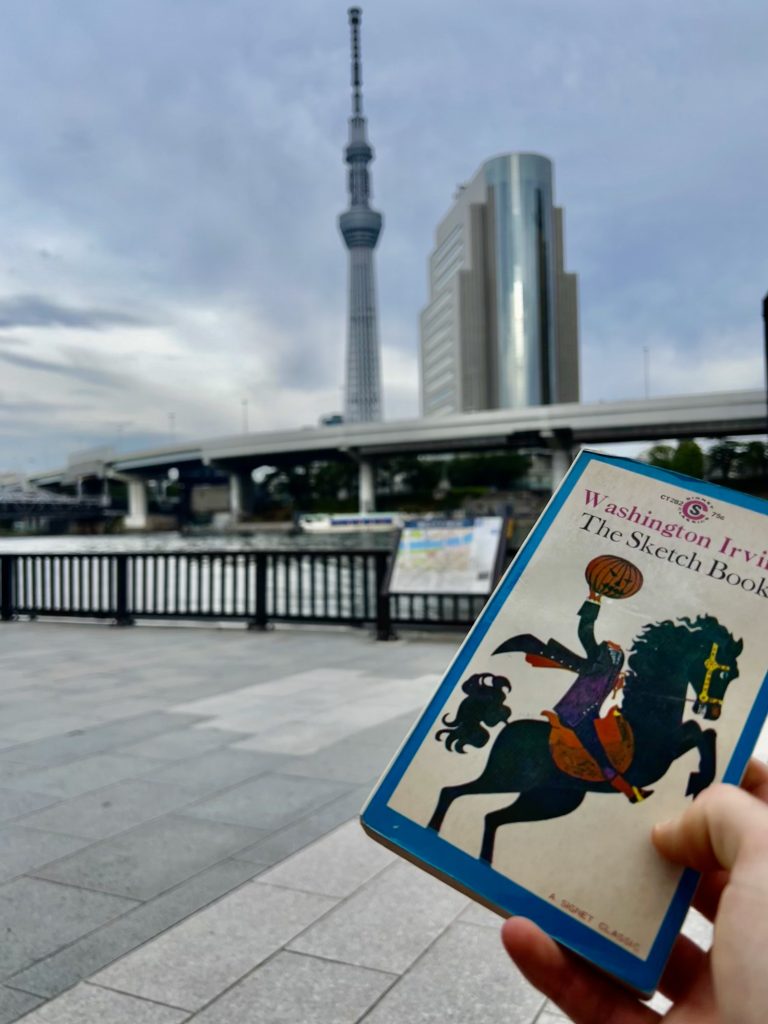
In the first chapter, Irving writes:
“It has been either my good or evil lot to have my roving passion gratified. I have wandered through different countries and witnessed many of the shifting scenes of life. I cannot say that I have studied them with the eye of a philosopher, but rather with the sauntering gaze with which humble lovers of the picturesque stroll from the window of one print shop to another, caught sometimes by the delineations of beauty, sometimes by the distortions of caricature, and sometimes by the loveliness of landscape.”
Washington Irving was an early-19th-century American writer of varying styles, and an American ambassador to Spain in the 1840s. This book comprises sketches with words; portraits of place; meanderings into ideas and cultural observations. That’s what I love. That’s me.
This book found me for a reason.
It reminds me of The Seasons Quartet, by Karl Ove Knausgaard, the writer who’s inspired me perhaps more than any other. Again, that awakening took place in a bookstore. Not the sleepy wooden interior of a Tokyo haunt, but a rather posh San Francisco bookstore about seven years ago.
I came across Autumn, by Knausgaard, and the cover captivated me. Four books comprise The Seasons Quartet, each book full of essays on assorted topics relating to that season.
Those books are beautiful and exemplify what I love about Knausgaard, which is his ability to write about anything with brilliant depth, drawing the profundity from the mundane like water from a well. If he could write that way, using his every experience and interest as material, then I could, too. It’s largely because of Knausgaard and his My Struggle series that I became a writer.
As I sat on the river reading The Sketch Book, everything clicked. Irving describes his transatlantic voyage from America to England:
“As I saw the last blue line of my native land fade away like a cloud on the horizon, it seemed as if I had closed one volume of the world and its concerns, and had time for meditation before I opened another. That land, too, now vanishing my view, which contained all most dear to me in life; what vicissitudes might occur in it, what changes might take place in me before I should visit it again! Who can tell, when he sets forth to wander, whither he may be driven by the uncertain currents of existence, or when he may return, or whether it may ever be his lot to revisit the scenes of his childhood?”
This . . . This! For some untold reason, I feel kindred with Irving and his calling to wander. Little excites me more than better understanding a time and place through the heartfelt words of a long-gone soul.
I’ve thought about making something like this before, which is why I started writing my Japan field notes — pithy observations, essays, and forays into Japanese culture as experienced by a foreigner. But I think this oughta be my next project. Time will tell.
At around 8 p.m., after an iconic dinner on a bustling, izakaya-lined road of Asakusa, Pat and I made our way back to the bookstore.

The vibe of the bookstore was merry; the lights were now dimmed; and the owner, Nick, wore a backwards hat to class it up a bit. We made a bet about whether you’d be back, he said as I approached the bar.
I’m shocked myself, I replied. About twenty people filled the shop at a time, leisurely coming and going, perusing the shelves, and performing a song or poem at the open mic. I put my name down on the sheet to perform and was nervous for the next forty minutes.
But I took deep breaths and thought to myself, everybody in here is just like you. We’re just people. Be present, listen to the music, and fucking enjoy this.
I found a community in Tokyo, made of expats and locals, little kids and wise elders, drifting through their own existence.
And for a night, a moment, they showed themselves and surrendered a piece of their soul on a makeshift stage in the back of a used bookstore, surrounded by color, history, and heartfelt words of long gone souls.
And maybe they renewed a piece of themselves, like me. My name was called. I played some tunes. Pat and I hung out, and then we left into the warm summer night, where both the river and my heart were shining.
No, I’m not sick of Japanese culture. It still astounds me; but I have realized that it’s okay to feel low — it’s okay to be angry, pissed, sad, lonely, and frustrated. We don’t have to hide these necessary emotions from the world and from ourselves. Embracing these emotions clears the energy inside of us, making room for what’s important.
And that’s the return to love, friendship, and even that sense of sheer wonder, which, no matter how life gets me down, always seems to return in the end.


No Comments